Children in foster care often carry trauma that affects how they interact with the world around them. These responses aren’t always easy to identify, but they are essential to understanding the emotional and behavioral patterns that emerge in your home.
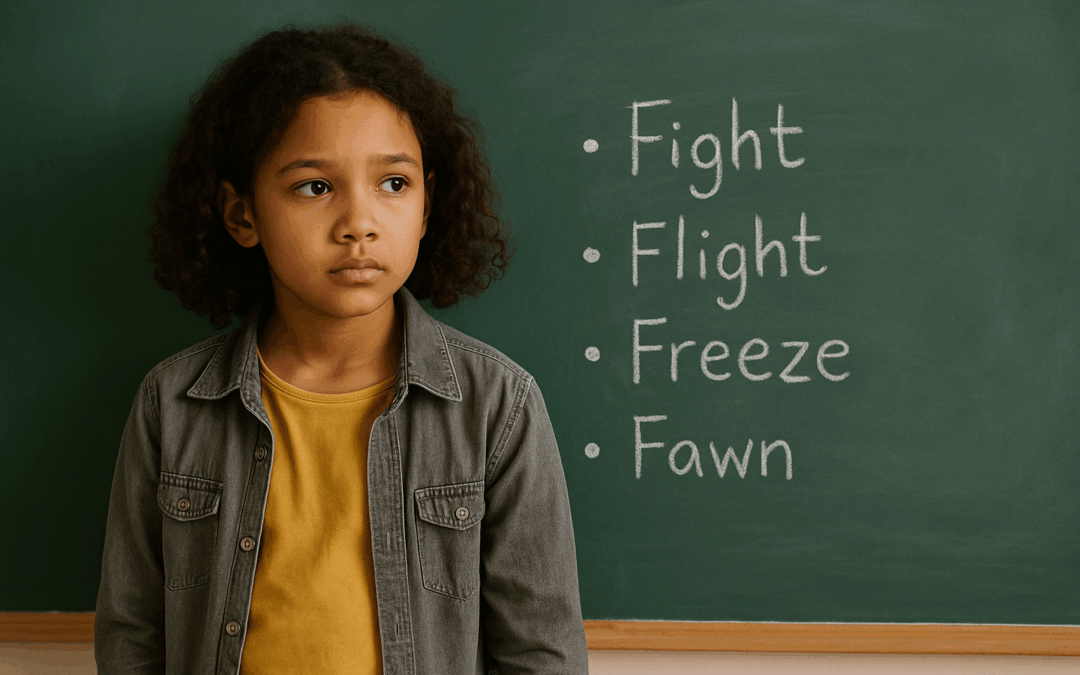
As a foster parent, learning about the four primary trauma responses—fight, flight, freeze, and fawn—is a must because it can be a game changer with everything. It stops you from asking, “Why are they acting like this?” and asking, “What happened to them?” Just this shift in one’s perspective opens doors that lead to healing for everyone, the child and you.
Trauma Lives in the Body
According to van der Kolk (2014), trauma is not only stored in our memory, but our bodies as well will store trauma, but differently. That means children who are in foster care, who have lived through prolonged stress, abuse, or neglect, will not feel safe while in a safe place. Their brains and bodies are always going to be wired for danger. The trauma they have will never go away; there are no magic words that will make the trauma go away. The effects of the harmful environments they have been in will always linger in their minds and bodies and come out in everyday situations they endure. And this is why you need to understand. They’re not giving you a hard time, they’re having a hard time.
The Four Fs: Fight, Flight, Freeze, and Fawn
The way they react to different situations and environments is a trauma response due to experiences from when the child did not feel safe, felt abandoned, and possibly powerless. The following will break down each response: fight, flight, freeze, and run, so you might have a better idea of what to look for in your home.
Fight
This response is the most common and easiest one to notice. It comes off looking like aggression, defiance, yelling, tantrums, name-calling, or property destruction. A child in fight mode might constantly argue with you or escalate a situation over seemingly minor things. This, for them, is a survival response, not trying to disrespect you or dominate the situation at hand.
Over time, they learn that being combative may have been the only way to feel powerful in an environment where they felt defeated or helpless. They have learned that if they lash out first, they won’t get hurt later. They know they will be moved to a new home if lucky. Because the next home may be better, and if not, they will just work on getting moved again. But nowadays, they are running out of places to put kids into. Remember, disrespect is often a desperate attempt to regain control of their own life.
Flight
Although Flight may sound like they are physically running away, it is always possible. It can also mean a child who:
- Can’t sit still
- Avoids eye contact
- Hides in their room or behind furniture
- Escapes into books, screens, or fantasy
- Appears “hyper” or extremely fidgety
Their body puts them on high alert. They may be safe and in no danger at the moment, but their brain is telling them to RUN! Often, the kids may look hyper or unable to focus in the moment. But what’s happening is that their nervous system doesn’t feel safe enough to rest or be still, and it makes them react the way they do.
Freeze
Freeze is the most powerful and also the hardest response to see. A child might shut down completely:
- No talking
- Blank stares
- Motionless during conflict
- Disengaged from play or conversation
- Unable to make decisions
Kids are often carrying deep internal distress, and some of the common labels they will have in school or home environments are quiet, good, or easy. In their past, going silent may have been the safest response if flight or fight was not an option for them, so instead, they disappear emotionally. They freeze up.
Fawn
Fawn is the least understood response and is common in foster care. Fawn mode in children comes off as:
- Tries too hard to please
- Laughs when nervous
- Hides their own needs
- Over-apologizes or avoids conflict
- Acts overly affectionate to strangers
These children may seem they are doing fine and happy, but they’re masking fear. They’ve learned that they are safe if they are easygoing and helpful, but in doing so, they lose touch with their own boundaries and voices.
What This Looks Like in a Foster Home
In my own experience as a foster parent, I’ve seen all four trauma responses. Sometimes it can be from the same child, all within the same week. Trauma doesn’t stay in a single lane, it can be all over the road.
We had one child who burst into tears after accidentally stepping on our cat. The cat yowled, and this poor kid just collapsed in panic. Later, we learned that even minor accidents were punished severely in their old home. There was no room for mistakes. They weren’t being dramatic. They were freezing, and their brain had learned that making a mistake equals danger.
Another child had an intense reaction to encouragement. If they were encouraged too much, “You’ve been doing great in school,” they’d shut down, stop doing their school work, and be a pain to the school staff. With the help of their teacher and the para, we eventually learned that praise was tied to a sudden change in their past—praise meant things were about to go wrong. Most of the time, to my understanding, they would be praised before removal. Encouragement felt unsafe. Their fight response was about their memory.
There’s no one-size-fits-all reaction. Every behavior has a backstory. Every child needs different attention, approaches, and care to work with them.
Responding with Care
As foster parents, it’s not our job to fix trauma. We will never be able to fix it or have magic words or parenting hacks that erase years of pain. But we can be a healing presence by responding differently.
Trauma-informed parenting means asking, “What’s the need underneath this behavior?” Then from there, you try to meet that need without fear, shame, or rejection. That often looks like:
- Staying calm, even when the child is not
- Regulating your emotions first
- Offering a safe structure, not harsh discipline
- Validating their feelings without feeding the fear
- Repeating routines over and over
- Letting them “fail safely” without punishment
- Focusing on connection over correction
Unbeknownst to my wife, through lots of conversations, she helped me find consistent approaches that helped:
- Stay calm and grounded, even when they were not.
- Learning to validate feelings: “It’s okay to be scared. You’re safe now.”
- Offer safe choices to restore a sense of control.
- Use body-based calming tools like breathing, rocking, or sensory objects.
- Follow up with connection, not consequences.
Partnering With Teachers: Extending Trauma-Informed Care Beyond the Home
One of the most impactful steps I’ve learned in trauma-informed foster parenting is that you can’t do it alone. And that includes what happens outside your home, especially at school.
Teachers, counselors, and school staff are on the front lines with your child for hours daily. Some administration staff, I have learned, don’t care, as sad as it sounds, it is the truth. If they don’t understand trauma, they misread behaviors and unintentionally escalate situations. A child who shuts down in class or reacts harshly to redirection again isn’t necessarily being disrespectful. They might be freezing or fighting, but the school’s lack of trauma and kids is the issue.
That’s why open, ongoing communication with teachers is essential. When we foster children, one of the first things I noticed was which teachers I could team up with. Most of the time, they would stand out independently. Within a month or so, we exchanged phone numbers, and sometimes our communication was daily. One teacher I met for coffee about once a week, because he cared so much about one of my children. He wanted to know what he could do differently to help them. Not to overshare or label them, but to explain:
“This child has experienced trauma. Sometimes they get overwhelmed or triggered. Here’s what helps at home, and we’d love to be on the same page with you.”
Simple strategies like using calm tones, offering choices, providing sensory breaks, or not singling them out in front of peers can make a huge difference.
I have worked with amazing educators who adjusted their approach after just one conversation. One teacher began sending short positive emails at the end of each week. This wasn’t a reward, but a way to build trust. The same teacher had a quiet room so our foster child could go and sit and be alone as a reward if they got their stuff done and had no issues all week.
When home and school are aligned, children feel safer. That consistency teaches them that adults can be trusted. You don’t have to be afraid everywhere you go.
Foster parents and teachers don’t have to walk the same journey, but when they share a roadmap, the path forward becomes much smoother for everyone involved.
The Impact on You as a Foster Parent
All of this takes a toll. Consistently showing up in the face of intense behavior is exhausting, but it’s also work that shouldn’t be taken lightly.
When you learn to see a meltdown as a moment of vulnerability—not defiance—you stop reacting and start responding. You become a safe harbor when you pause to hold space for fear rather than punish it. You begin to see change. It is not something that happens overnight.
But as time goes by, you start to see the kids who once shut down start to open up. Kids who used to run begin to stay. The kids who fought you start to trust you.
A Personal Reflection
One of the greatest lessons trauma-informed parenting has taught me is this. Sometimes the thing in the way is fear, sometimes grief, and sometimes it’s because they never learned other ways.
But once you start to understand the Four Fs, not just in theory but also by learning how to use them in messy day-to-day routines, you start to feel less powerless and more prepared. And the child in your care? They begin to feel safe enough to grow.
Conclusion
I did not learn about fight, flight, freeze, and fawn till after the first foster kids we took in. But after learning about them with them, learning to understand the responses has changed how I parent, not just with our foster children, but with our biological kids, too. Trauma-informed care has helped me become more cautious than reactive, more patient than punitive, and more connected than controlling.
More importantly, it’s helped the children in our home feel less ashamed of the behaviors that once defined them. These children are not broken, like everyone else. They’re protecting themselves. And slowly, they’re learning to let that protection down and start to trust.
Our job as a foster parent isn’t to fix. It’s to stay.
References
van der Kolk, B. A. (2014). The body keeps the score: Brain, mind, and body in the healing of trauma. Viking.